Compare the patterns
Timings are in seconds: breathe in, hold, breathe out, hold empty. Breaths per minute is for one full cycle; most adults breathe 12 to 20 times a minute at rest.
| Pattern | Timing | Breaths/min | Holds | Session | Best for |
|---|---|---|---|---|---|
| Morning Boost | 4-2-2 | 7.5 | Yes | 1:20 | Waking up, before exercise, a natural energy lift |
| Quick Calm | 4-6 | 6 | No | 2:00 | Settling quickly before a meeting or after a stressful moment |
| Coherent 5-5 | 5-5 | 6 | No | 2:00 | A daily calming practice with no holds |
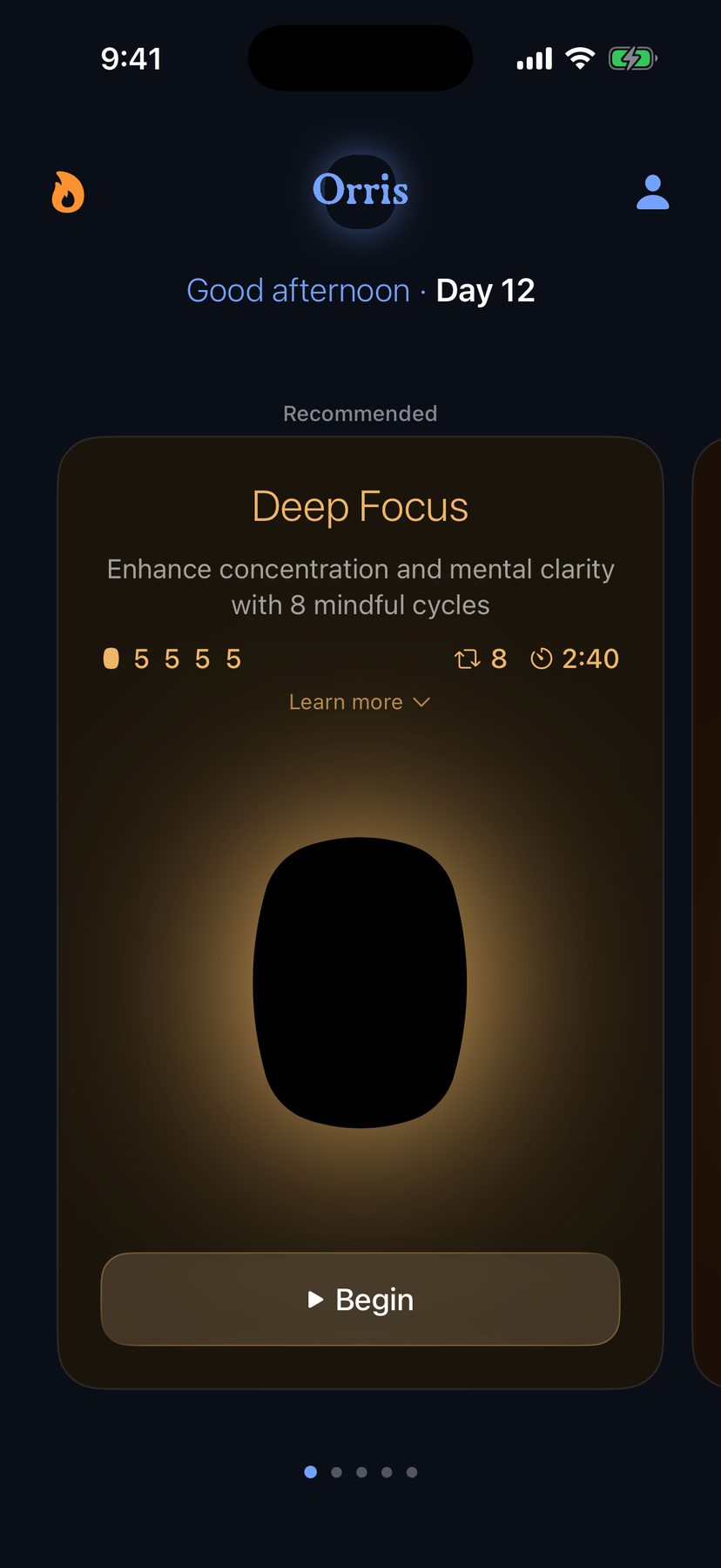
| Deep Focus | 5-5-5-5 | 3 | Yes | 2:40 | Before deep work or studying |
| Box Breathing | 4-4-4-4 | 3.8 | Yes | 2:08 | Staying steady and focused under pressure |
| Sleep Prep | 4-4-8 | 3.8 | Yes | 3:12 | Winding down before bed |
| 4-7-8 | 4-7-8 | 3.2 | Yes | 2:32 | Falling asleep, interrupting anxious thoughts |
| Extended Exhale | 4-8 | 5 | No | 2:00 | Calming down without breath holds; an easy way into sleep breathing |
Which one should you use?
For sleep
To calm down
For focus
For energy
Frequently asked questions
Which breathing exercise is best for sleep?
Patterns with a long exhale work best for winding down. 4-7-8 breathing is the best known; Sleep Prep (4-4-8) is similar with a shorter hold; and extended exhale breathing (4-8) skips holds entirely, which makes it the easiest to start with.
Which breathing exercise is best for anxiety or stress?
Exhale-focused patterns like Quick Calm (4-6) and extended exhale settle you quickly, and coherent breathing works well as a daily practice. If breath holds make you more anxious, choose a pattern without them. Breathing exercises are not a substitute for treatment.
Which breathing exercise is best for focus?
Box breathing (4-4-4-4) and Deep Focus (5-5-5-5) use equal phases with holds, which give your attention a steady rhythm to follow.
Which breathing exercise is best for beginners?
Coherent breathing (5-5) or Quick Calm (4-6). Neither has holds, and both are easy to keep up.
How long should a breathing exercise be?
Two to five minutes is enough for most people. Every Orris session runs between about one and three minutes by default, and you can change the cycle count.
Safety. Breathing exercises are generally safe, but stop and breathe normally if you feel dizzy, lightheaded, or short of breath. If you are pregnant or have a heart, lung, or blood pressure condition, check with your doctor before practicing breath holds. Orris is a wellness app and does not replace medical advice.
Practice it with Orris
Orris guides every one of these patterns with an animated shape and haptic cues, recommends one for the time of day, and lets you build your own with per-phase timing. Sessions log to Apple Health, and widgets keep your streak in view.
Every breathing pattern in Orris is free, with no account and no ads.

Last updated October 2026.