How to do coherent breathing
- Sit comfortably and let your shoulders drop.
- Breathe in gently through your nose for a count of five.
- Without pausing, breathe out for a count of five.
- Turn smoothly from in to out, like one continuous wave.
- Continue for two minutes (twelve breaths) or longer.
At a glance
| Pattern | Breathe in 5s · Breathe out 5s |
|---|---|
| One cycle | 10 seconds |
| Pace | 6 breaths per minute |
| Breath holds | None |
| Orris session | 12 cycles, 2:00 (adjustable) |
| Best for | A daily calming practice with no holds |
When to use it
Coherent breathing works well as a daily practice and whenever you want a smooth, even rhythm. Because it has no holds, it is one of the easiest patterns for beginners and for anyone who finds breath holds uncomfortable.
Why it works
Your heart speeds up slightly as you breathe in and slows as you breathe out. At around six breaths a minute, that rhythm lines up with the body's blood pressure reflexes, so the swings in heart rate get as large as they can. Larger, regular swings mean higher heart rate variability.
What the research says
Breathing at this resonance pace, about six breaths a minute, is the core of heart rate variability biofeedback, which has been studied for conditions ranging from anxiety and depression to asthma. The leading explanation is that it exercises the baroreflex, the body's blood pressure control loop.
Each person's exact resonance rate differs slightly, usually between about four and a half and seven breaths a minute. Six is the common starting point.
- Lehrer PM, Gevirtz R. Heart rate variability biofeedback: how and why does it work? Frontiers in Psychology, 2014.
- Zaccaro A, Piarulli A, Laurino M, et al. How breath-control can change your life: a systematic review on psycho-physiological correlates of slow breathing. Frontiers in Human Neuroscience, 2018.
Tips
- Think of the breath as one continuous wave.
- Don't pause at the top or bottom. Let each phase roll into the next.
- Breathe through your nose if you can, and keep it quiet and easy rather than deep and forced.
Safety. Breathing exercises are generally safe, but stop and breathe normally if you feel dizzy, lightheaded, or short of breath. If you are pregnant or have a heart, lung, or blood pressure condition, check with your doctor before practicing breath holds. Orris is a wellness app and does not replace medical advice.
Practice it with Orris
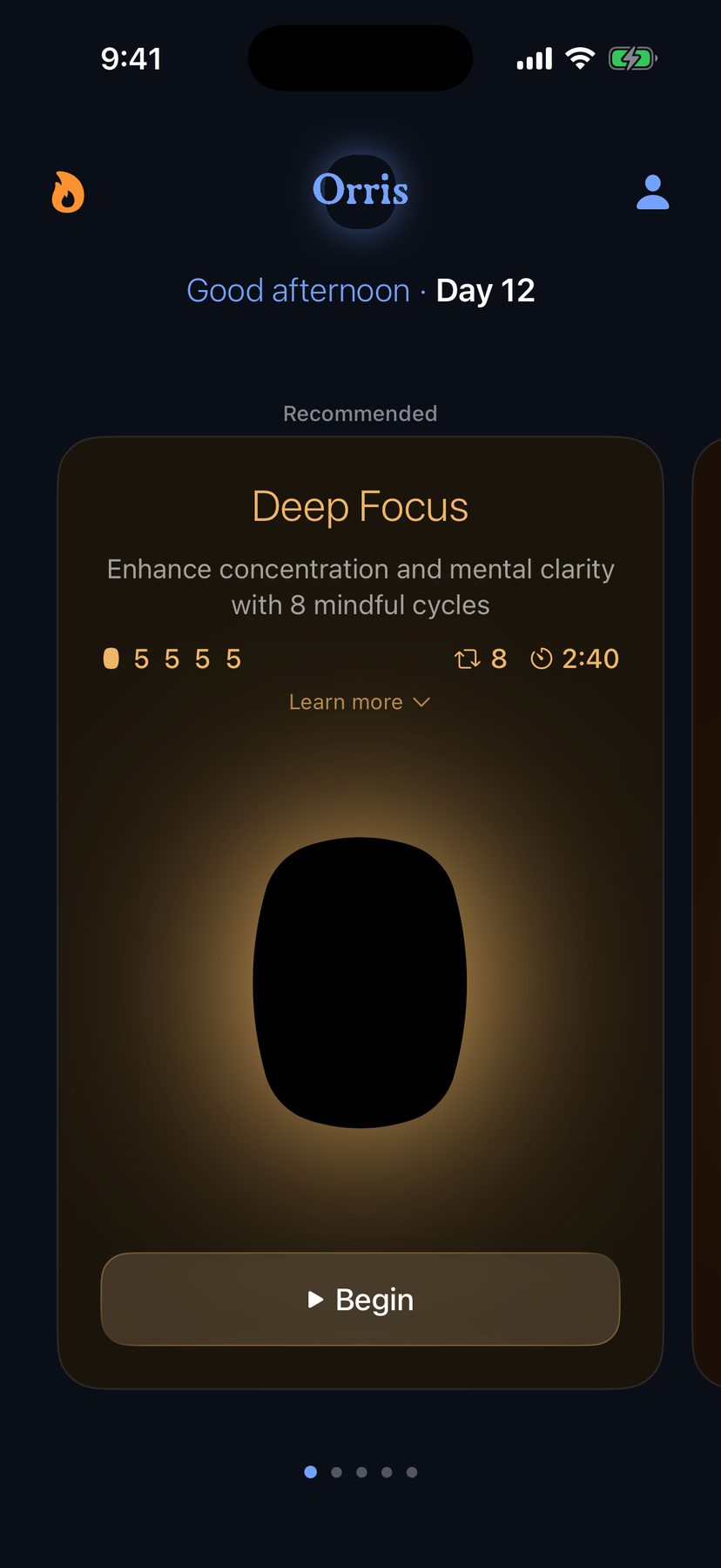
In Orris, Coherent 5-5 is drawn as two stacked, rounded pills that swell on the inhale and settle on the exhale, with haptic cues that follow each breath. A session is twelve breaths (2:00) by default. Quick Calm (4-6) is a close cousin with a slightly longer exhale.
Every breathing pattern in Orris is free, with no account and no ads.

Frequently asked questions
What is the difference between coherent breathing and box breathing?
Coherent breathing has two equal phases and no holds, at about six breaths a minute. Box breathing adds holds after the inhale and the exhale and runs slower, under four breaths a minute.
Why six breaths per minute?
It is close to most adults' resonance frequency, the pace where heart rate and breathing synchronize and heart rate variability peaks.
Is coherent breathing the same as resonance breathing?
Yes, the terms are used interchangeably. Resonance breathing sometimes refers to a rate tuned to your personal resonance frequency, while coherent breathing usually means a fixed five in, five out.
Is coherent breathing good for beginners?
Yes. With no holds and an even count, it is one of the easiest patterns to start with.
Last updated October 2026.