How to do 4-7-8 breathing
- Sit or lie down comfortably. If you like, rest the tip of your tongue on the ridge behind your upper front teeth, as Dr. Weil teaches.
- Breathe out completely through your mouth.
- Close your mouth and breathe in quietly through your nose for a count of four.
- Hold your breath for a count of seven.
- Breathe out through slightly pursed lips for a count of eight.
- Repeat. Start with four cycles and build up as it gets comfortable.
At a glance
| Pattern | Breathe in 4s · Hold 7s · Breathe out 8s |
|---|---|
| One cycle | 19 seconds |
| Pace | 3.2 breaths per minute |
| Breath holds | Yes, 7s |
| Orris session | 8 cycles, 2:32 (adjustable) |
| Best for | Falling asleep, interrupting anxious thoughts |
When to use it
4-7-8 is a wind-down breath. Use it in bed when you can't fall asleep, or when you need to interrupt a spiral of anxious thoughts.
The ratio matters more than the exact seconds. If the seven-second hold feels too long, count faster and keep the 4:7:8 proportions.
Why it works
The exhale is twice as long as the inhale, and heart rate naturally slows while you breathe out. Together with the long hold, that pushes the nervous system toward its parasympathetic (rest and digest) state more strongly than equal-phase patterns like box breathing, which is why 4-7-8 often produces a distinct feeling of physical relaxation.
What the research says
A 2022 study of 43 young adults found that 4-7-8 breathing increased high-frequency heart rate variability, a marker of parasympathetic activity, in well-rested participants.
Direct evidence that 4-7-8 helps you fall asleep is still limited. Most of the support comes from research on slow breathing in general, which is linked to lower arousal and stress.
- Vierra J, Boonla O, Prasertsri P. Effects of sleep deprivation and 4-7-8 breathing control on heart rate variability, blood pressure, blood glucose, and endothelial function in healthy young adults. Physiological Reports, 2022.
- Zaccaro A, Piarulli A, Laurino M, et al. How breath-control can change your life: a systematic review on psycho-physiological correlates of slow breathing. Frontiers in Human Neuroscience, 2018.
Tips
- Exhale through slightly pursed lips. A soft whoosh is fine.
- If seven seconds feels long, scale the whole pattern down and work up.
- Feeling a little lightheaded the first few times is common. Return to normal breathing if it happens.
Safety. Breathing exercises are generally safe, but stop and breathe normally if you feel dizzy, lightheaded, or short of breath. If you are pregnant or have a heart, lung, or blood pressure condition, check with your doctor before practicing breath holds. Orris is a wellness app and does not replace medical advice.
Practice it with Orris
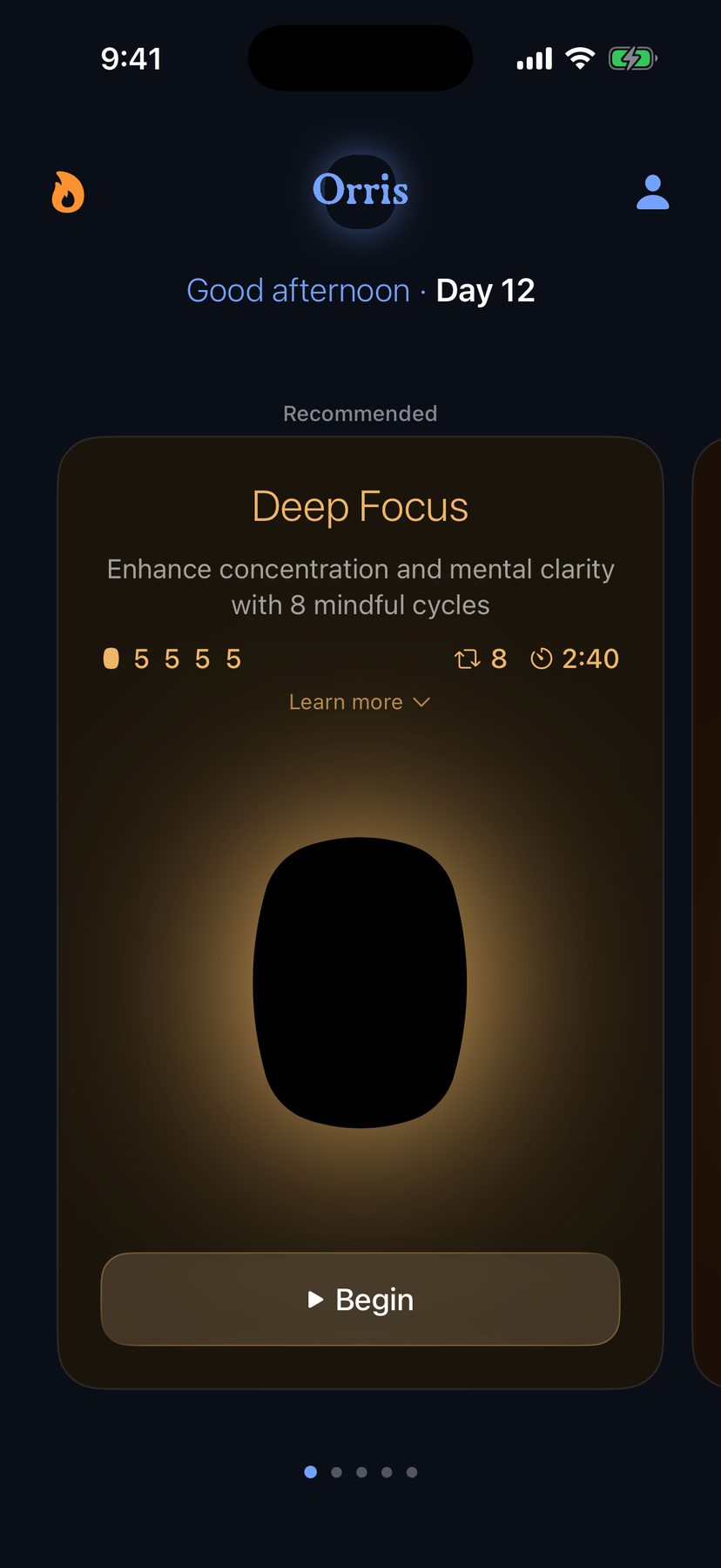
In Orris, 4-7-8 is drawn as a soft, curved triangle that fills on the inhale, rests through the hold, and slowly empties on the long exhale, with haptic cues so you can practice in the dark with your eyes closed. Orris also includes Sleep Prep (4-4-8) and Extended Exhale (4-8), gentler sleep patterns with shorter or no holds.
Every breathing pattern in Orris is free, with no account and no ads.

Frequently asked questions
Does 4-7-8 breathing help you fall asleep?
Many people find it helps them relax enough to drift off, and studies show slow breathing like 4-7-8 shifts the body toward a rest state. Research on 4-7-8 and sleep specifically is still limited.
How many times should I do 4-7-8 breathing?
Dr. Weil suggests starting with four cycles, about a minute and a quarter. Orris's default 4-7-8 session is eight cycles (2:32), and you can lower the cycle count.
Why do I feel dizzy doing 4-7-8 breathing?
The long hold and exhale change your breathing more than you are used to. Mild lightheadedness is common at first. Stop and breathe normally if it happens, and try shorter counts with the same ratio.
Is 4-7-8 better than box breathing?
They do different jobs. Box breathing is steadier and suits focus under pressure; 4-7-8 is more sedating and suits sleep. If holds feel uncomfortable, extended exhale breathing is a gentler alternative.
Last updated October 2026.