How to do extended exhale breathing
- Sit or lie down comfortably.
- Breathe in gently through your nose for a count of four.
- Breathe out slowly for a count of eight, through your nose or softly pursed lips.
- Go straight into the next inhale, without holding.
- Continue for two minutes (ten breaths) or longer.
At a glance
| Pattern | Breathe in 4s · Breathe out 8s |
|---|---|
| One cycle | 12 seconds |
| Pace | 5 breaths per minute |
| Breath holds | None |
| Orris session | 10 cycles, 2:00 (adjustable) |
| Best for | Calming down without breath holds; an easy way into sleep breathing |
When to use it
Use it in the evening as you wind down, or any time you want to calm down without breath holds. It is often the most approachable sleep breathing pattern for people new to breathwork, and a gentler on-ramp than 4-7-8.
Why it works
Your heart naturally speeds up a little as you breathe in and slows down as you breathe out. Making the exhale twice as long tips that balance toward slowing, and the slow overall pace (five breaths a minute) shifts the nervous system toward its rest state. It is the same mechanism that makes a sigh feel relieving, done on purpose.
What the research says
In a 2023 Stanford randomized trial comparing breathing exercises with mindfulness meditation, the exhale-focused technique (cyclic sighing) produced the largest improvement in mood and the biggest drop in resting breathing rate.
A systematic review of slow breathing found it was associated with higher heart rate variability and with feeling more relaxed and less anxious.
- Balban MY, Neri E, Kogon MM, et al. Brief structured respiration practices enhance mood and reduce physiological arousal. Cell Reports Medicine, 2023.
- Zaccaro A, Piarulli A, Laurino M, et al. How breath-control can change your life: a systematic review on psycho-physiological correlates of slow breathing. Frontiers in Human Neuroscience, 2018.
Tips
- Don't force the exhale. Let it lengthen naturally, like letting air out of a balloon.
- If eight seconds is too long, try four in and six out (Quick Calm) first.
- Let each exhale fully empty your lungs before the next breath in.
Safety. Breathing exercises are generally safe, but stop and breathe normally if you feel dizzy, lightheaded, or short of breath. If you are pregnant or have a heart, lung, or blood pressure condition, check with your doctor before practicing breath holds. Orris is a wellness app and does not replace medical advice.
Practice it with Orris
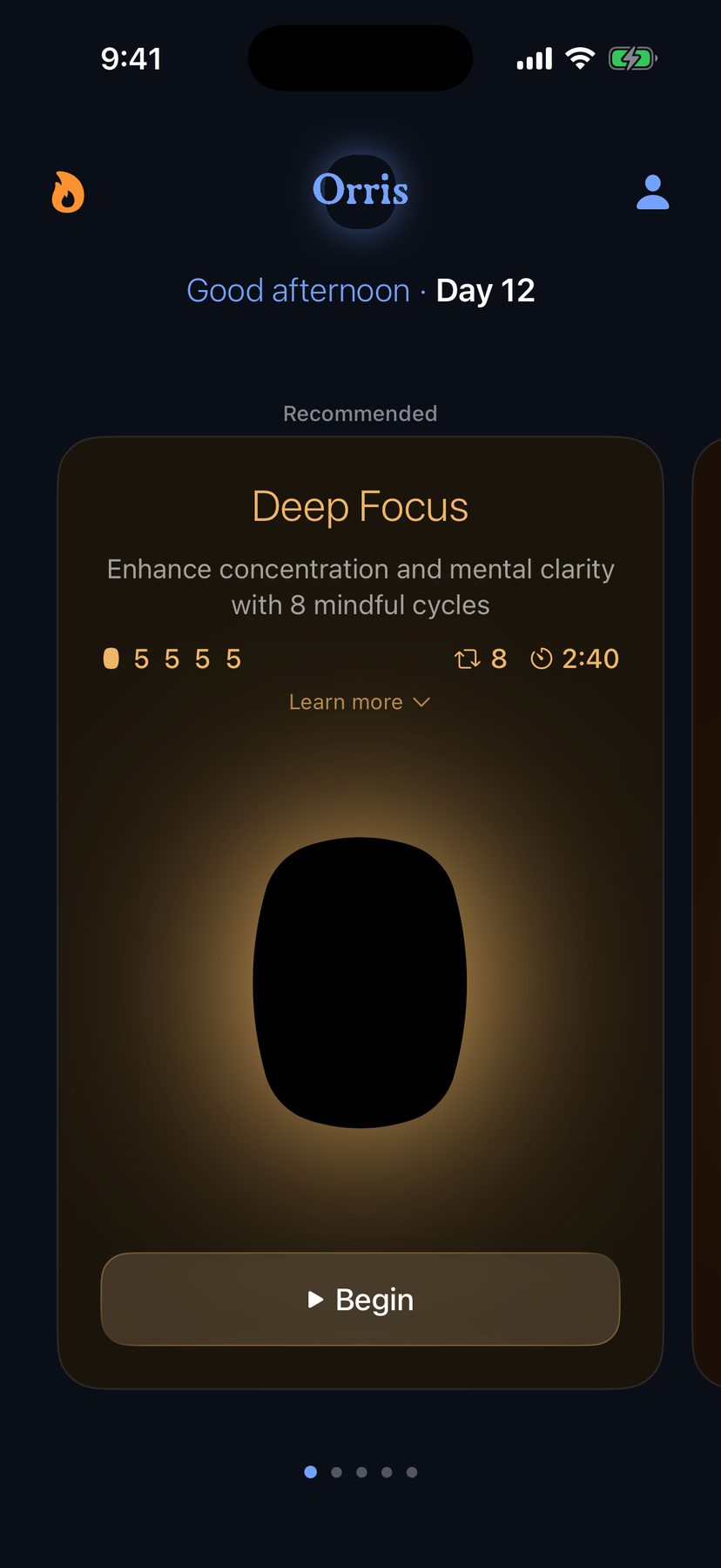
In Orris, Extended Exhale is drawn as a wide, rounded rectangle that fills on the inhale and drains slowly through the long exhale, with haptic cues so you can follow along with your eyes closed. A session is ten breaths (2:00) by default. Orris also includes Sleep Prep (4-4-8), which adds a short hold, and Quick Calm (4-6) for a gentler ratio.
Every breathing pattern in Orris is free, with no account and no ads.

Frequently asked questions
Why does a longer exhale calm you down?
Heart rate slows during each exhale. Making the exhale longer than the inhale means more time in that slowing phase, and the slow pace shifts your nervous system toward rest.
What is the difference between extended exhale and 4-7-8 breathing?
Both use an eight-second exhale. 4-7-8 adds a seven-second hold after the inhale; extended exhale has no holds, so it is easier to do and easier to keep up.
Should I breathe out through my nose or mouth?
Either works. Breathing out through softly pursed lips makes it easier to slow the exhale; breathing out through your nose is quieter, which some people prefer in bed.
How long should I do it?
Two minutes is enough to feel a difference. Orris's default session is ten breaths (2:00).
Last updated October 2026.